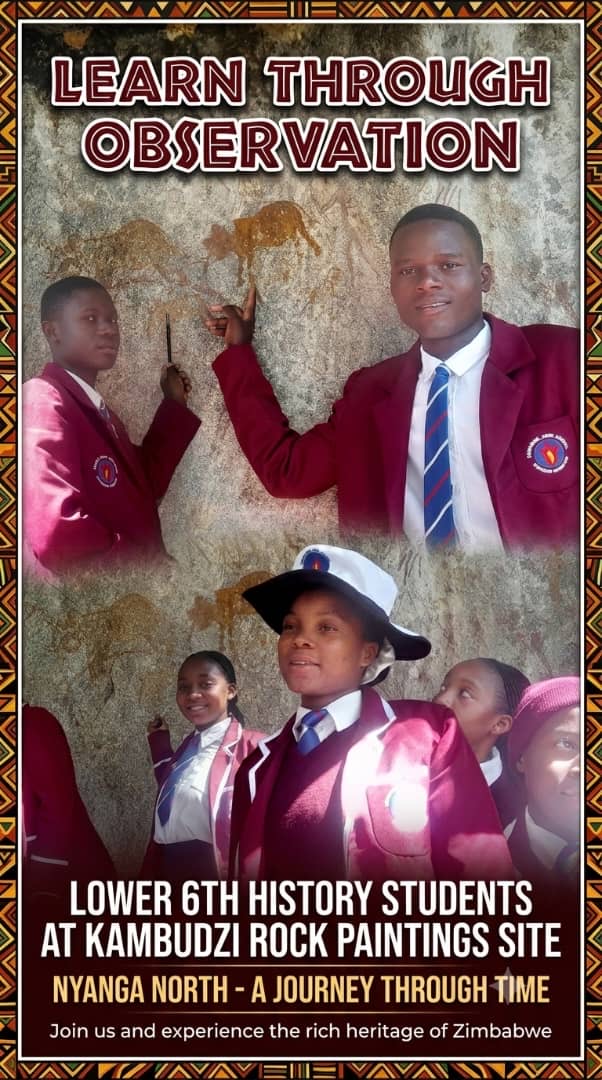
← Back to NewsOn Friday, 12 June 2026, a crisp winter breeze swept across the rugged landscapes of Nyanga North, but the biting cold was not enough to dampen the spirits of the Emmanuel High School Lower 6th History class. Leaving their traditional textbooks and desks behind, these enthusiastic learners embarked on a pathbreaking educational field trip to the *Kambudzi Rock Paintings site*, located in the heart of Kambudzi Village.
The primary motive of this journey was to explore and deeply appreciate Zimbabwe's cultural heritage in an area that many people often dismiss as remote or inaccessible. More importantly, the expedition was designed to bring history to life through direct observation. This practical approach directly fulfills the demands of the *Heritage, a progressive educational framework championed by the Ministry of Primary and Secondary Education to connect classroom theories with real-world national treasures.
By observing these ancient rock canvases firsthand, the students did not just memorize facts; they analyzed how early human populations ingeniously adapted to their natural environments. Educators note that decoding the survival strategies of the past helps modern students develop critical thinking and problem-solving skills—essential tools required to navigate and succeed in our fast-changing 21st-century world.
Braving the Wilds of Kambudzi.
The journey to the site was a true test of physical endurance and determination. To reach the historical sanctuary, the Lower 6th students had to brave the freezing morning temperatures and push through thick, thorny, and bushy terrain. Their path led them up a steep, rocky hill where the ancient artists chose to leave their permanent mark on the landscape.
Guiding the students safely through this challenging terrain were two local experts who provided invaluable grassroots knowledge:
Sabhuku Kambudzi: The respected village head, who holds the oral histories and traditional custody of the land.
Mr. Chanzenza: A proud resident of the village and an alumnus (former student) of Emmanuel High School, bridging the gap between past school generations and current learners.
A Fascinating Masterclass in Ancient Art and Daily Life.
Upon reaching the granite rock shelters, the students were greeted by an astonishing sight: the vibrant paintings remain remarkably visible despite centuries of exposure to the elements. The rock face serves as a massive visual diary of early San (Late Stone Age) populations, filled with detailed representations of animals, reptiles, and human figures actively hunting with highly specialized bows, arrows, and spears.
The artwork allowed the history students to easily interpret the economic, social, and political lifestyles of these early societies. A prominent theme across the walls is group hunting, which provides undeniable evidence of a strong spirit of cooperation, communal harmony, and collective responsibility among the early inhabitants of Kambudzi and the wider Nyanga North region.
Two specific artistic depictions left the touring party completely spellbound.
Notable Painting Features: Historical Significance & Interpretation
| The Giant Elephant |
A massive centerpiece drawing that covers almost the entire rock surface. In a remarkable display of artistic layering known as *superimposition*, smaller animals—including monkeys, swift hares, and nimble bucks—were painted directly on top of the elephant, indicating a deeply interconnected view of wildlife and spiritual symbolism.|
| The Honey Harvester |
A highly advanced scene showing an intimate understanding of the domestic utility of fire. The drawing depicts a man lighting a fire using a bundle of twigs tied tightly together. He is seen using the controlled smoke to calm a wild bee colony, allowing him to safely harvest honey from a beehive—a brilliant showcase of early resource management. |
Dismantling Eurocentric Myths Through Chemistry.
Beyond the beauty of the art, the students arrived at a significant realization: these early inhabitants were far ahead of their time in terms of intellect, innovation, and technological development.
The creation of complex tools like the composite bow and arrow required high-level engineering. Even more striking was the realization that these ancient people possessed a sophisticated grasp of chemistry. To make paint that could bind permanently to granite and withstand centuries of changing weather, they had to precisely harvest, crush, and mix specific natural ingredients—such as iron oxides, charcoal, plant sap, animal fat, and blood.
A Legacy of Civilization
For decades, biased, Eurocentric historical narratives falsely claimed that Africans were unprogressive and uncivilized before European colonization. The sophisticated rock galleries at Kambudzi Village stand as undeniable, undeniable physical testimony to the contrary. They prove that Zimbabwe's ancient ancestors were highly evolved thinkers, innovators, and scientists who mastered their environment with great intelligence.
A Call to Action: The Battle Against Time and Human Activity
After hours of intense learning, documentation, and discussion, the Emmanuel High School students prepared to leave the hill in an incredibly jovial, celebratory mood. They left with a profoundly renewed sense of pride in their cultural identity. Before departing, the students earnestly engaged Sabhuku Kambudzi, encouraging him and local authorities to take immediate, structured steps to preserve this priceless heritage site for future generations.
The village head strongly shared their passion but took the opportunity to voice his deep frustrations regarding local environmental destruction. Sabhuku Kambudzi lamented that a growing number of people are cutting down trees for firewood in the immediate vicinity of the sacred hill.
He explained with fierce determination that deforestation strips away the dense natural woodland that acts as a protective shield for the site. Without this forest canopy, the area becomes completely exposed to trespassers, land encroachers, and direct environmental hazards, which will accelerate the permanent destruction of the rock art.
His plea is an urgent race against time. As the years progress, the kambudzi rock paintings are increasingly suffering from natural weathering and moisture exposure, causing some of the delicate lines and pigments to grow worryingly faint. The successful Emmanuel High School field trip highlights a critical national truth: protecting the treasures of Nyanga North is not just the job of the village head, but a vital duty for students, historians, and the entire Zimbabwean community.
Academics
Lower 6th History trip to KAMBUDZI ROCK PAINTING (NYANGA NORTH)
20 June 2026
ECHOES FROM THE GRANITE WALLS: EMMANUEL HIGH SCHOOL STUDENTS UNCOVER ANCIENT GENIUS IN NYANGA NORTH!